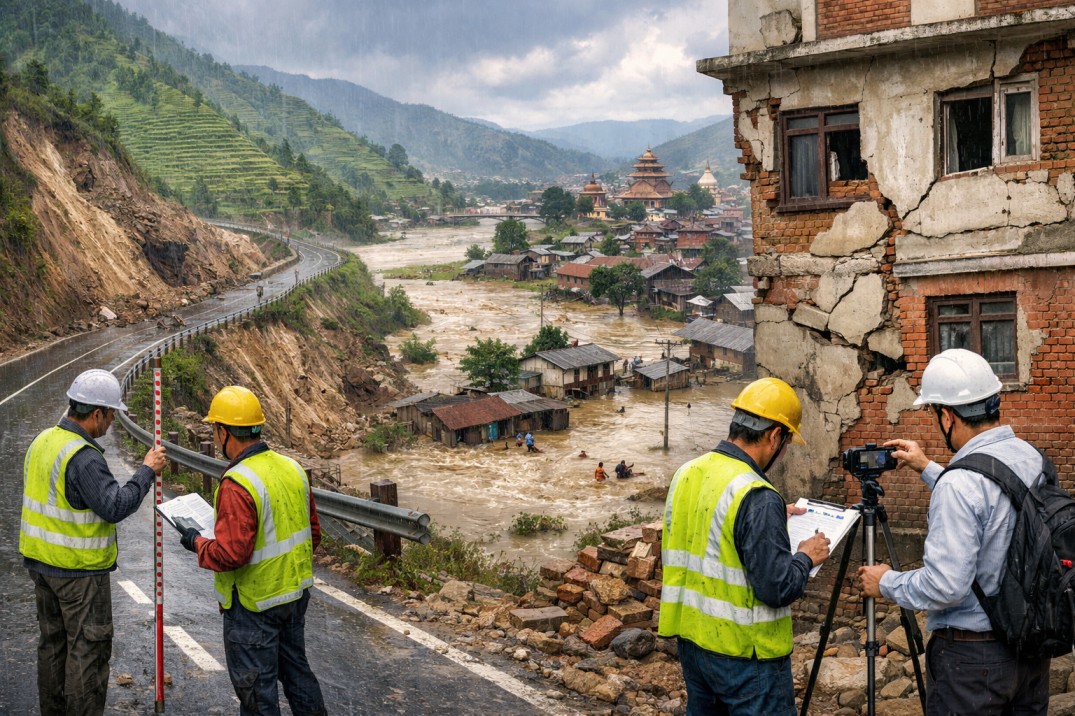
Infrastructure Resilience and Disaster Mitigation in Nepal
January 30, 2026Sulav pradhan
In Nepal, disasters are rarely surprises. They follow patterns shaped by fragile geology, steep terrain, intense monsoon rainfall, and rapid but often unplanned development. For civil engineers, disaster resilience is not a separate field—it is embedded in everyday decisions about how and where we build.
Many recent disaster impacts in Nepal reveal a common issue , infrastructure failure linked to engineering oversight rather than extreme events alone. Landslides along highways such as the Narayanghat–Muglin and Muglin–Pokhara road sections frequently occur at locations where slope cutting, drainage provision, and protection works were insufficient. Heavy rainfall triggers failure, but the root cause is often long-term instability created during construction.
Similarly, flooding in areas like the Terai plains and urban centers such as Biratnagar, kathmandu and Nepalgunj is intensified by undersized drainage systems, encroachment on natural waterways, and inadequate river training works. From a civil engineering perspective, many of these issues could be mitigated through proper hydrological analysis, floodplain zoning, and routine maintenance of culverts and canals.
Earthquake performance offers another clear lesson. During the 2015 Gorkha earthquake, traditional masonry buildings without seismic bands or proper connections suffered severe damage, while structures that followed basic earthquake-resistant detailing performed noticeably better. This highlighted an important truth that “codes alone do not save lives—implementation does”. Even simple measures such as lintel bands, vertical reinforcement, and controlled material quality can drastically improve structural behavior during seismic events.
Geotechnical investigation remains one of the most neglected aspects of construction in Nepal. Buildings constructed on soft soil or old river deposits like in Kathmandu Valley which often experience differential settlement and amplified seismic effects. Skipping soil investigation may reduce initial project costs, but it increases long-term risk to both structures and occupants.
Civil engineers also play a critical role after disasters occur. Following floods or earthquakes, rapid structural and slope assessments determine whether roads can reopen, bridges can carry traffic, or buildings are safe to occupy. Premature use of damaged infrastructure has, in several cases, led to secondary failures and accidents. Trained engineering judgment during post-disaster assessment is therefore as vital as emergency response itself.
Disaster resilience in Nepal cannot rely solely on relief efforts. It must be designed, detailed, constructed, and maintained into infrastructure from the beginning. This requires coordination among engineers, municipalities, contractors, and policymakers, along with accountability at every stage of development.
For Nepal, resilience is not about building massive structures everywhere—it is about building appropriate infrastructure informed by local risk. When civil engineering principles are applied with care and responsibility, disasters may still occur, but their impact on lives, communities, and the economy can be significantly reduced.