Who Rescues the Rescuers?
September 28, 2026-Ashma Khadka
A rescuer is trained to blindly run towards the chaos while everyone else runs away from it. But when the sirens fade, the crowds disperse, and the emergency is declared over, what happens to the people who were left carrying what they had witnessed?
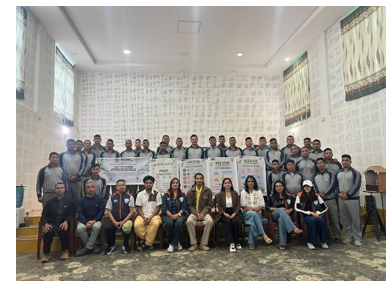
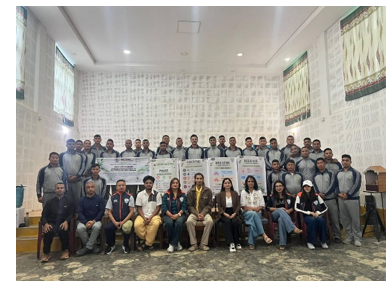
On 27 September 2026, at 2:20 P.M., the APF Headquarters School of Music, Halchowk, Swayambhu, Kathmandu became a space for that question to be addressed, not through another briefing or debriefing, but through silence, breathing, music and rest. The Nepal Disaster Resilience Foundation (NRDF), in collaboration with Aarogya Man, Nepal Yoga Alliance and Trivena Yogshala, conducted ‘First Responder: Stress Management and Restorative Wellness Programme ', a mental wellness initiative designed specifically for members of the Nepal Police Force who had been involved in the arduous rescue operations following the devastating Rasuwa flood of 2026.
Thirty-two police personnel, ranging from young adults aged 18 and above to individuals in their late forties, gathered for the session. They arrived not in their capacity as rescuers, protectors, or first responders, but merely as people who had been through a calamitous misfortune and deserved the opportunity to breathe. The programme therefore sought to create a tranquil environment in which the police personnel could temporarily step away from their demanding responsibilities and devote time to their own mental and physical restoration.
The programme was facilitated by Ms. Pramila, Ms. Nimrita, Mr. Nabin and Mr. Krishna, professionals working in the fields of psychology and healing, alongside Mrs. Regina Pradhan, President of NRDF.
Opening and Recognition
The programme commenced with an opening address by Mrs. Regina Pradhan, who expressed profound appreciation for the Armed Police Force and the service they had provided during the Rasuwa flood rescue mission. Her address went beyond acknowledging their physical efforts. She also recognized the emotional and psychological trauma that first responders may carry after being exposed to distressing and life-threatening situations. This acknowledgement established the tone of the programme, making it clear that the wellbeing of the rescuers themselves was equally worthy of attention.
Ms. Pramila Khanal Sharma, founder of Aarogya Man, went on to articulate the motive of the programme: to establish a serene environment where the police personnel could experience a sense of ease. The objective was not to demand resilience from people who had already demonstrated it, but rather, to permit them to temporarily put their responsibilities aside.
Phase I: Grounding the Mind and Releasing the Weight
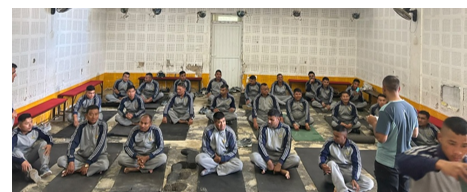
The first phase focused primarily on psychological grounding, bodily awareness and practical stress management. The participants were requested to sit in a U-shaped formation before beginning a series of warm-up and relaxation exercises.
The exercises began with conscious attention to breathing, followed by repeated chanting of “Om”, rubbing the hands together to generate warmth and placing the warmed hands over the eyes. The participants also engaged in foot exercises and several forms of stretching. A soft tune played in the background to subtly reinforce the atmosphere of serenity.
The participants were encouraged to pay attention to the sounds surrounding them, whether the calls of birds, passing vehicles, or other small noises that might ordinarily disappear into the background. The exercise encouraged them to return their attention to the present moment rather than remaining trapped in memories of the past or anxieties about what might come next.
Ms. Pramila subsequently conducted the principal psychological session, during which she introduced the participants to a series of practical steps that could be followed when confronted with overwhelming stress or distressing circumstances.
The steps were:
a) Move to a safe place.
b) Pause, recognize and absorb your surroundings.
c) Practice calming breathing techniques to help release sudden waves of stress.
d) Seek connection, whether through friends, acquaintances or any trusted person.
e) Recognize where stress manifests most strongly in the body.
f) Follow established team protocols.
The discussion also highlighted an important physiological dimension of prolonged stress. When stress is bottled up over an extended period, it can affect not only one's psychological wellbeing but also one's physical health. Recognizing stress, therefore, is not an indulgence but an important part of caring for the body itself. After the first phase, the participants were given a ten-minute break, allowing them to transition from psychological awareness into deeper physical restoration.
Phase II: Release, Reset and Restore
The second phase, led by Guru Krishna, approached wellness through physical relaxation. It was divided into two sections: “Release and Reset” and “Settling Down Through Vibrations and Affirmations.”
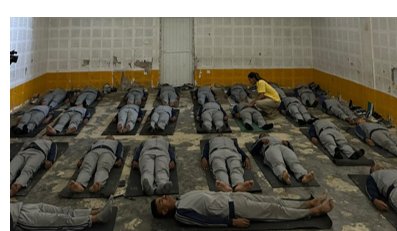
The participants first lay down comfortably on yoga mats and began a series of regulated breathing exercises. An upbeat piece of music played in the background while Guru guided the participants to synchronise their breathing with its rhythm. The activity created a noticeable transition from the more instructional first phase towards a deeper state of physical relaxation.
The atmosphere changed considerably during the second section. The thundering music was replaced by the much softer and more soothing sound of a flute. Guru guided the participants through what felt like a peaceful mental journey that encouraged them to gradually detach from external pressures and turn their attention inward.
As the session progressed, incense was lit and gently moved over the participants. The team also used singing bowls, ringing them close to each participant's face and hovering them over different parts of the body. These practices were intended to promote relaxation and facilitate healing through vibrations and the balancing of chakras. Guru then remained seated on the stage while playing and ringing his various instruments, allowing the sounds to permeate the entire room.
The resulting atmosphere was mellifluous, serene and deeply tranquil. The combination of soft music, controlled breathing, affirmations, incense and resonant vibrations created an hour of almost complete stillness. A majority of the police personnel eventually fell asleep during the relaxation journey, which suggested how deeply they had settled into the experience.
Throughout the session, Guru also repeated various affirmations that allowed the participants to temporarily unburden their shoulders from the responsibilities and pressures they had been carrying. For approximately an hour, the room became a space in which the first responders were not required to rescue, respond, or remain alert. Instead, they were encouraged simply to rest and focus on themselves.
When asked how it felt, the participants did not reach for complicated explanations. Their answer was simple: “Ekdamei Aananda”. And perhaps that said everything. For nearly an hour, the singing bowls rang, the flute drifted through the room and one by one, the participants slipped into deep relaxation, with many eventually falling asleep. The rescuers who had spent days responding to crisis were finally given the chance to switch off.
Interaction and Conclusion
When provided the opportunity to speak with Ms. Nimrita about her profession and her experience in the field over the past one and a half years. She described the work as “healing” for herself, a perspective that offered an interesting insight into the nature of wellness work. Supporting others through difficult experiences can itself become a deeply pivotal process.
What lingered most was the shift in atmosphere throughout the session. The APF police personnel had entered the programme carrying experiences that could not simply be left behind with the end of a rescue mission. However, for a brief period, they were given an environment in which they could acknowledge those experiences without having to explain or confront them directly.
Perhaps the most poignant lesson of the afternoon was that resilience cannot be endlessly extracted without being replenished. Those who repeatedly confront catastrophe may develop remarkable endurance, but endurance, too, requires restoration.