Starting at Zero: Rebuilding Life after Disaster
October 03, 2026Ashma Khadka
Disasters do not arrive with the courtesy of a warning. They arrive in mere minutes and turn peaceful, ordinary lives into desperate calculations of what can still be saved. The Bhotekoshi-Rasuwa flood has exposed that precarious reality, leaving families to salvage what they can from homes, livelihoods and lives upended by the rising waters.
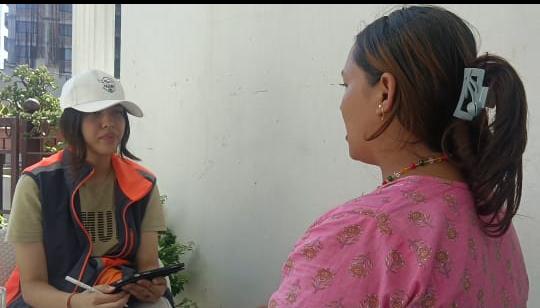
Among them is 23-year-old Sabita Shrestha, who turned to the Nepal Disaster Resilience Foundation (NDRF) after losing her home and life as she knew in Nuwakot. Sabita came to collect relief from NDRF on September 30, and with her, she carried a devastating story that began with a warning she and her family initially did not take seriously.
At around 8:30 a.m. on the morning of the flood, Sabita and her husband were informed that the river was rising. Living near the river in Nuwakot, they did not immediately realise the danger.
“We received information around 8:30 a.m. in the morning. We didn’t think much of it and took it lightly. We even joked that we would go fishing since we live near a river,” she recalled.
That lightheartedness, however, disappeared when the flood reached Betrawati.
Sabita and her husband Sukuman Chitrakar, 32, fled their home for Tallo Pipaltar. In the chaos of leaving, Sabita suddenly remembered that their important documents had been left behind.
She immediately sent her husband back to retrieve them.
“He made it back safely, but barely,” she said gravely.
Their house was soon completely engulfed by the river. So was the furniture outlet that had been the family's primary source of livelihood. Sukuman had built his career in the furniture industry, with the business employing around 200 people at its peak. The couple survived. Their life, however, had changed completely.
Sabita had lived in Kathmandu before her marriage and had been married for only a year and a half when the deadly flood struck. After escaping, she and her husband stayed with relatives for several days before moving into a rented flat in Tarkeshwor, Kathmandu, where they currently reside.
Today, Sukuman is unemployed, having lost the furniture business that was his primary source of experience and income. Sabita, who studied up to +2 and has received training in veterinary work and beauty parlouring, now works at a nearby beauty parlour to support herself and her husband while slowly learning to build her life back brick by brick.
The sudden reversal in their circumstances has been difficult to put into words.
“From one way, we have become beggars. We were once moguls who gave 200 people employment,” Sabita said, her eyes glistening with tears.
Yet after the initial panic, she began looking for ways to move forward. Sabita turned to AI sources for information about the steps she could take after the disaster. Her search eventually led her to NDRF. She had also approached other organisations for assistance, but said she was given little priority because her family had not experienced a human loss. When she found NDRF's website and social media pages, she said she saw “a ray of brightness.”
She contacted the organisation through its official WhatsApp account and requested relief and asking for assistance was not easy. Sabita had been accustomed to providing for herself and her family, and now found herself dependent on relief for basic necessities. Even proving the extent of her losses required effort.
With online fraud and false claims becoming a concern in disaster-relief efforts, NDRF asked Sabita to provide photographs of her house before and after the flood. Fortunately, she had an unusual form of evidence. During her wedding, a drone had captured an aerial photograph of her house. The photograph had originally been taken to preserve a memory of a new chapter in her life. After the flood, however, it became evidence of the chapter that had been washed away.
NDRF provided Sabita and her husband with clothes, food, sanitary products, toiletries, utensils and other essential supplies. The organisation also maintained consistent communication with her, responding to her requests and bringing additional necessities as needed. She said she was more than satisfied with the relief and immensely grateful for NDRF's immediate response and clear communication.She also credited her brother for trying his best to provide support in the aftermath of the disaster.
The flood has altered more than Sabita's financial circumstances. It has also changed her understanding of who she can depend on. Sabita said she has more than 400 cousins and relatives, yet none offered assistance or even called to ask how she was doing.
“You really know who your well-wishers are during such arduous circumstances,” she said.
When asked what NDRF could do differently, Sabita hesitated before explaining that cash assistance would have been more useful to her than material relief because of her current circumstances. NDRF President Regina Pradhan clarified that the organisation is not mandated to provide direct cash assistance, but seeks to support affected families through other forms of relief.
For Sabita, however, recovery is not simply about replacing what was lost, but rather about learning to live with the loss while finding the determination to start again.
“The key is patience,” she said. “I know I can’t let go of my emotions. I know I’m at zero right now and I know I need to work hard, but I can’t let that set me back. With God’s blessing, I know anything is possible.”
Her story is a reminder that disasters do not end when the water disappears. For those left behind, the harder work of living with what was lost is only beginning.